How frequently should we measure axial length in myopia management practice, and how should it best direct our treatment strategy? Colleagues raised questions about this in the Myopia Profile Facebook group (link)- here we discuss how axial length change is related to refraction and ethnicity, and how to determine whether an axial length change is normal due to emmetropization or indicating myopia progression.
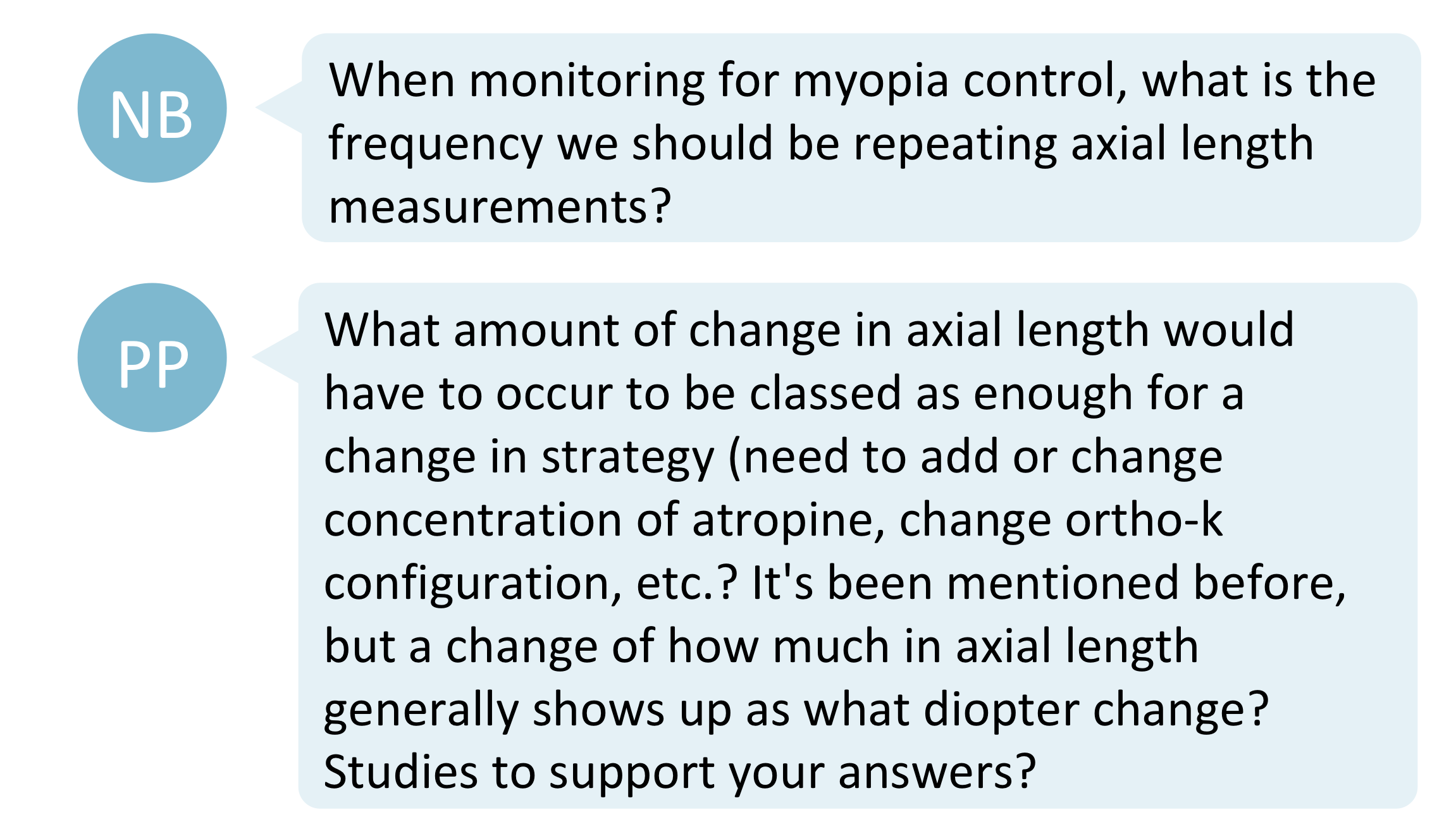
我们应该多久测量一次轴向长度?
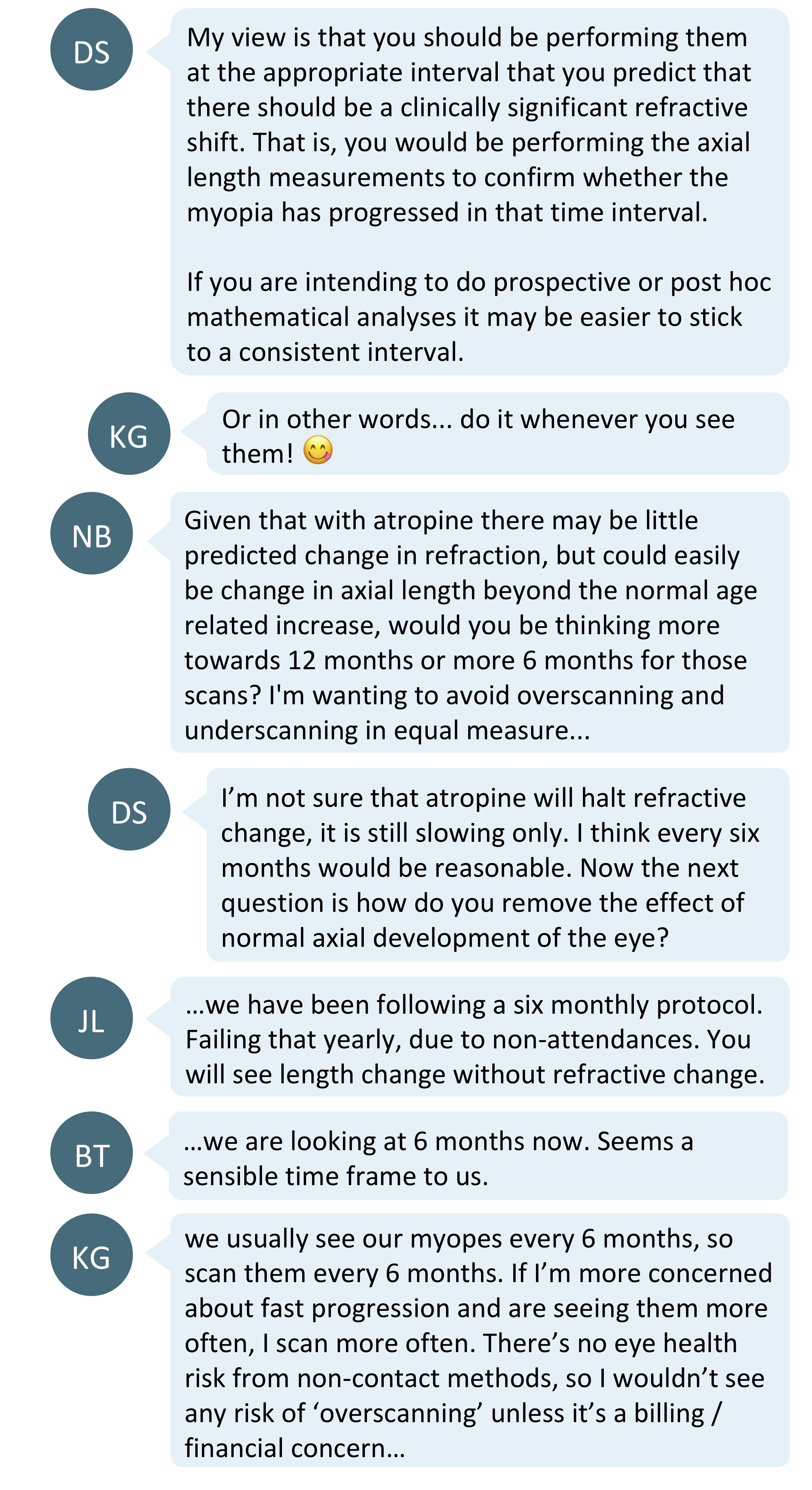
Most commenters suggest monitoring myopic patients every 6 months or to see them more often if the patient is a faster progressor.
There were also discussions about how to determine the normal, expected amount of axial length change in children due to emmetropization, and separating this normal growth from myopia progression growth.

Jones et al also shows that the corneal curvature of myopes tends to stay stable whilst emmetropes’ flatten over time. An emmetropes’ cornea flattens while axial length increases, maintaining a balance in emmetropia. Meanwhile, a myope’s cornea does not change in curvature with axial length change, leading to an increase in myopic refractive error.1不过,这并不全部与角膜有关 - 结晶镜可能在近视发育中发生的屈光成分的平衡丧失中起着更大的作用。Mutti及其同事2发现在变成近视的儿童中,结晶镜在对雌性杂志的儿童中进行了类似的稀疏,变平和失去权力。然而,在近视发作的一年内,晶体镜头停止了这些补偿性变化,这些变化在整个正常儿童轴向伸长率中继续存在。同样,重要的是要记住,儿童轴向长度增加的某些组成部分并不表示近视进展,实际上是正常的。
如果您希望将患者的轴向长度变化与Emmetrope的预期轴向长度变化进行比较,则可以使用源自Emmetrope的生长曲线得出的公式,如TA所建议。1这将使从业者能够将与近视相关的异常轴向长度变化与正常生理轴向长度生长。该模型仅适用于不到10.5岁的儿童。一个不同的模型适用于10.5岁以上的年龄:= 21.353 + 0.759 x LN(年龄)。有关更多信息,请参见下面的参考文献1。
轴向长度是如何改变与屈光error?

As described inSix questions on axial length in myopia managementthe refraction-to-axial-length ratio is variable across age groups, studies and the range of both measurements so isn’t so easy to simply define. A big part of the complexity is due to the variability in measurement of both refraction and axial length. Here are two exampes from multifocal contact lens myopia control studies. In the MiSight three year study,31mm = 2.40d的治疗组和对照组。在新发表的眨眼研究中41mm = 1.4 to 1.6D across the treatment and control groups. This is despite similar age ranges, ethnicities and methologies in both studies. The simple answer? We’re still learning.
How is axial length change related to ethnicity?
下表显示了Diez PS等人报道的轴向伸长的百分位数和Tideman JW等。5,6This shows that children of Chinese descent have longer axial lengths than those of European descent.
| Percentile | 女性 | 男性 | |||
| European | Chinese | European | Chinese | ||
| 6年 | 25 | 21.66 | 22。03 | 22.14 | 22。55 |
| 50 | 22。06 | 22。54 | 22。59 | 22.99 | |
| 75 | 22.49 | 23.04 | 23.01 | 23。50 | |
| 9 years | 25 | 22.33 | 23.16 | 22。83 | 23。70 |
| 50 | 22。79 | 23.72 | 23。31 | 24.32 | |
| 75 | 23。25 | 24.31 | 23.79 | 24。89 | |
| 15 years | 25 | 22。68 | 23.83 | 23.17 | 24.39 |
| 50 | 23.15 | 24.37 | 23.65 | 25.01 | |
| 75 | 23.65 | 25.20 | 24。21 | 25.80 | |
How much change in axial length is required for a change in myopia control strategy?
There is no definite value suggested for one to change the strategy. Given the variability in axial length change based on age and ethnicity, the best approach is to change strategy if the current one does not sufficiently reduce myopia progression. This can be gauged when progression is higher than that expected as reported in the literature.
轴向长度进展can be gauged using the percentile charts above - a child who jumps to a higher percentile over time is likely demonstrating accelerated growth.
为了使用文献中的另一个例子,彗星渐进式奇观镜头试验分析了各种因素,以影响近视进展,发现最牢固的关系与基线年龄有关。进行性添加晶状体(PAL)干预在三年内仅显示出很小的治疗效果。在一个种族多样化的群体中评估了轴向长度的伸长率(46%的白人,26%的非裔美国人,15%的西班牙裔,8%的亚洲人,5%混合)。7
Firstly, annual increases in overall axial length were 0.28 mm (± 0.01) between baseline and 1-year visit (at which time the children were 10.3 years on average); 0.21 mm (± 0.008) between 1 and 2 years (by age 11.3 years) and 0.17 mm (± 0.01) between 2 and 3 years (by age 12.3 years), reflecting the slowing in eye growth over time.
其次,当所有儿童(治疗PAL和对照SV奇观组)汇总结果时,三年来未经调整的轴向伸长率是:
- 6-7岁的孩子的1.08毫米
- 8岁的0.82毫米
- 9岁的年轻人0.68毫米
- 0.57mm in 10 year olds
- 0.45mm in 11 year olds.
为了确定治疗策略是否按预期工作,将比较单一视力中可能校正近视儿童的轴向伸长 - 如上所述 - 与该策略的预期百分比降低。更多帮助understanding efficacy you can read this blog, and also get more help ongauging success in this blog。
带回家消息:
- To monitor axial length change, the general consensus suggests 6-monthly measurements or more frequently in rapid progressors.
- We can monitor axial length change by comparing to the normative value expected for the patient’s age. If your patient’s result falls outside of normal limits, then it is worthwhile considering a more comprehensive myopia control strategy.
- Chinese children tend to have longer axial lengths and experience faster axial elongation than European children, even in normal emmetropic eye growth.
- 轴向伸长率在不同年龄段的情况下有所不同,年龄较大的孩子增加。
- Using axial length as a gauge of myopia management success is still a little difficult, but models exist as shown above. More research findings and development of growth charts for larger populations including a variety of ethnicities will help to answer this question.
Further reading:


This educational content is brought to you thanks to unrestricted educational grant from

References
- Jones LA,Mitchell L,Mutti DO,Hayes JR,Moeschberger ML,Zadnik K.儿童屈光误差组中眼部成分生长曲线的比较。临床和流行病学研究。2005; 46:2317-2327。(关联)
- Mutti DO, Mitchell GL, Sinnott LT, et al. Corneal and crystalline lens dimensions before and after myopia onset. Optom Vis Sci. 2012;89(3):251-262.(关联)
- Chamberlain P,Peixoto-De-Matos SC,Logan NS,NGO C,Jones D,Young G.近视控制的3年随机临床试验。Optom Vis Sci。2019; 96:556-567。((link)
- 后JJ,沃克可被做,等。的影响High Add Power, Medium Add Power, or Single-Vision Contact Lenses on Myopia Progression in Children: The BLINK Randomized Clinical Trial. JAMA. 2020;324:571–580.(关联)
- Diez PS,Yang LH,Lu MX,Wahl S,OhlendorfA。与近视相关的参数的生长曲线,以临床监测中国学童的屈光发展。Graefe的Arch Clin Exp Ophthalmol。2019; 257:1045-1053。(关联)
- Tideman JW, Polling JR, Vingerling JR, Jaddoe VW, Williams C, Guggenheim JA, Klaver CC. Axial length growth and the risk of developing myopia in European children. Acta ophthalmologica. 2018;96:301-309.(关联)
- Hyman L,Gwiazda J,Hussein M,Norton TT,Wang Y,Marsh-Tootle W,EverettD。在纠正近视评估试验中,年龄,性别和种族与近视的发展和近视的发展和轴向伸长率。Arch Ophthalmol。2005; 123:977-987。(关联)