Would you prescribe glasses for a young child with mild myopia? Is myopia control beneficial for a toddler? What are the key clinical considerations? KB shared an interesting case about a two-year-old child with -1.50D of myopia in the Myopia Profile Facebook group.
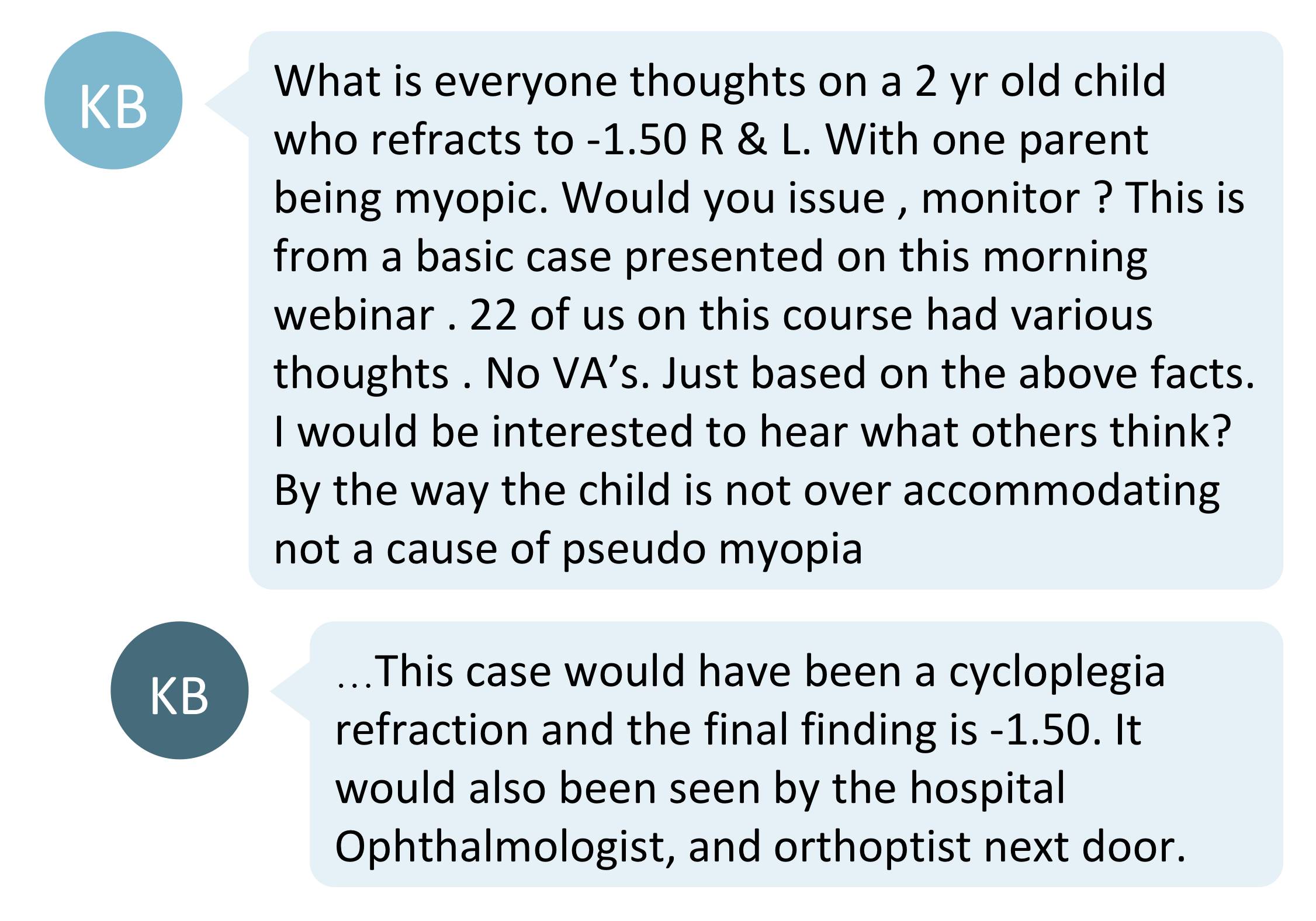
What are the considerations?
Limited research and patient information


目前,没有关于两岁儿童近视进展的可能性或典型率的研究。如果没有这种信息,我们无法确定性地证明近视控制是必要的,或者在那个年龄的情况下是有益的。
While commenters also highlighted that we lack other useful information such as the child’s axial length and binocular vision status, which could influence one’s management, there is question of how much value this provides in a child so young. The key management strategies at this age would be to ensure clear visual input to avoid amblyopia. If the child also had significant astigmatism or strabismus this would make the management simpler - vision correction and more active management would be required.
Even though the myopia is low, it is unusual to be myopic at such a young age - therefore it is critical to consider referring the child to an ophthalmologist to rule out any systemic co-morbidities. The mandatory nature of referral for a toddler with low myopia will depend on the scope of practice of primary eye care in your country. Once this care pathway has been satisfied according to your specific professional requirements in your country, it is likely that management of optical correction will fall back to the primary eye care practitioner. It is important to note that the case presented mentioned that the child had already seen an ophthalmologist, and the focus was on how to manage the refraction – to correct or not?
我们应该规划光学校正吗?
社区的意见是对这个孩子的管理层的意见。少数民族表示,他们会开设眼镜,而其余的会选择首先监察孩子。
“治疗”群体“
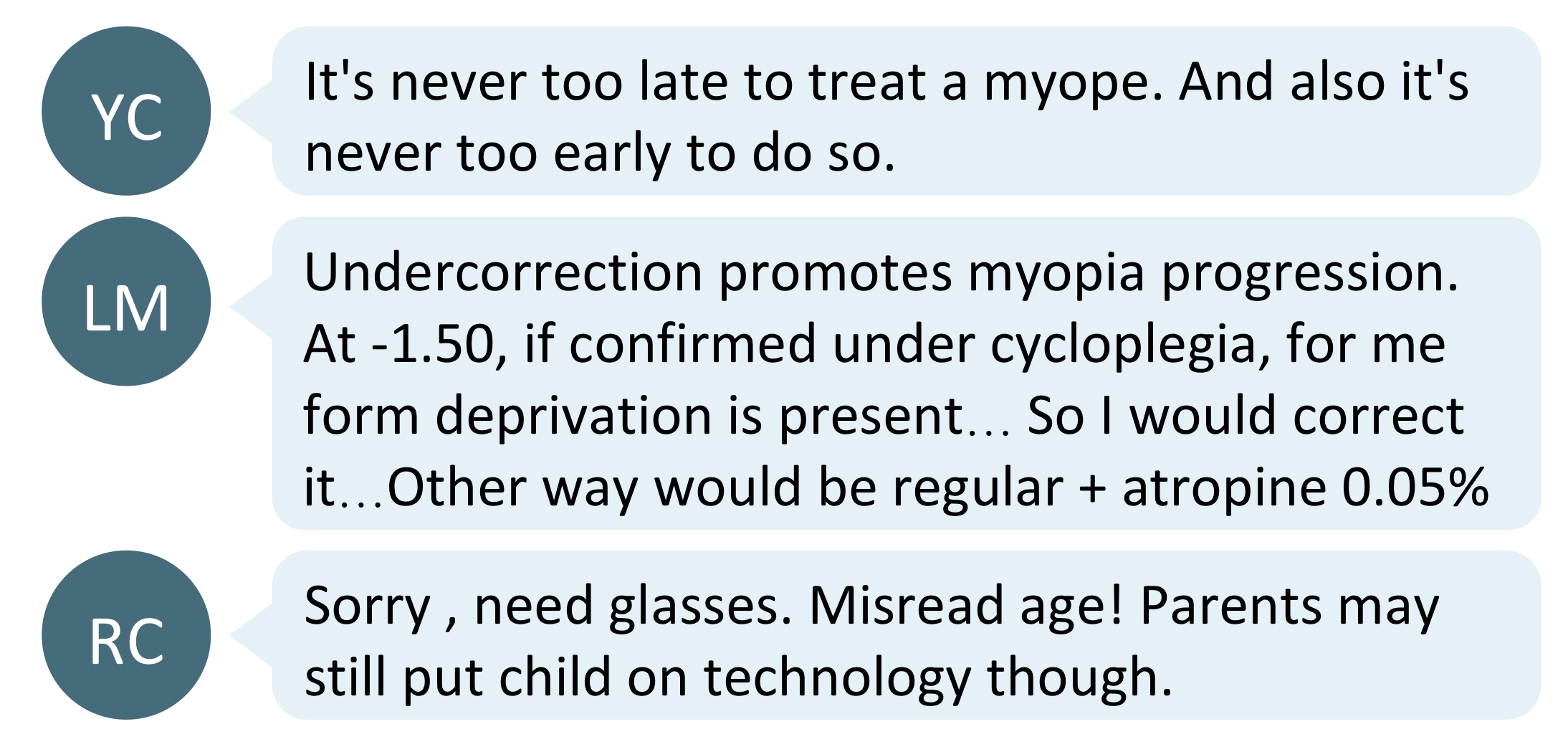
现有眼镜的理由是为了避免纠正,这已经建议与在下面的讨论中突出显示的近视近视增加。然而,重要的是要注意孩子,这个年轻人通常不包括在近视控制研究中,因此排泄物对两岁历史的影响是未知的。随后的讨论突出显示,在近视有害的排泄物上有一些猜想,以及研究适用于这个患者的程度。
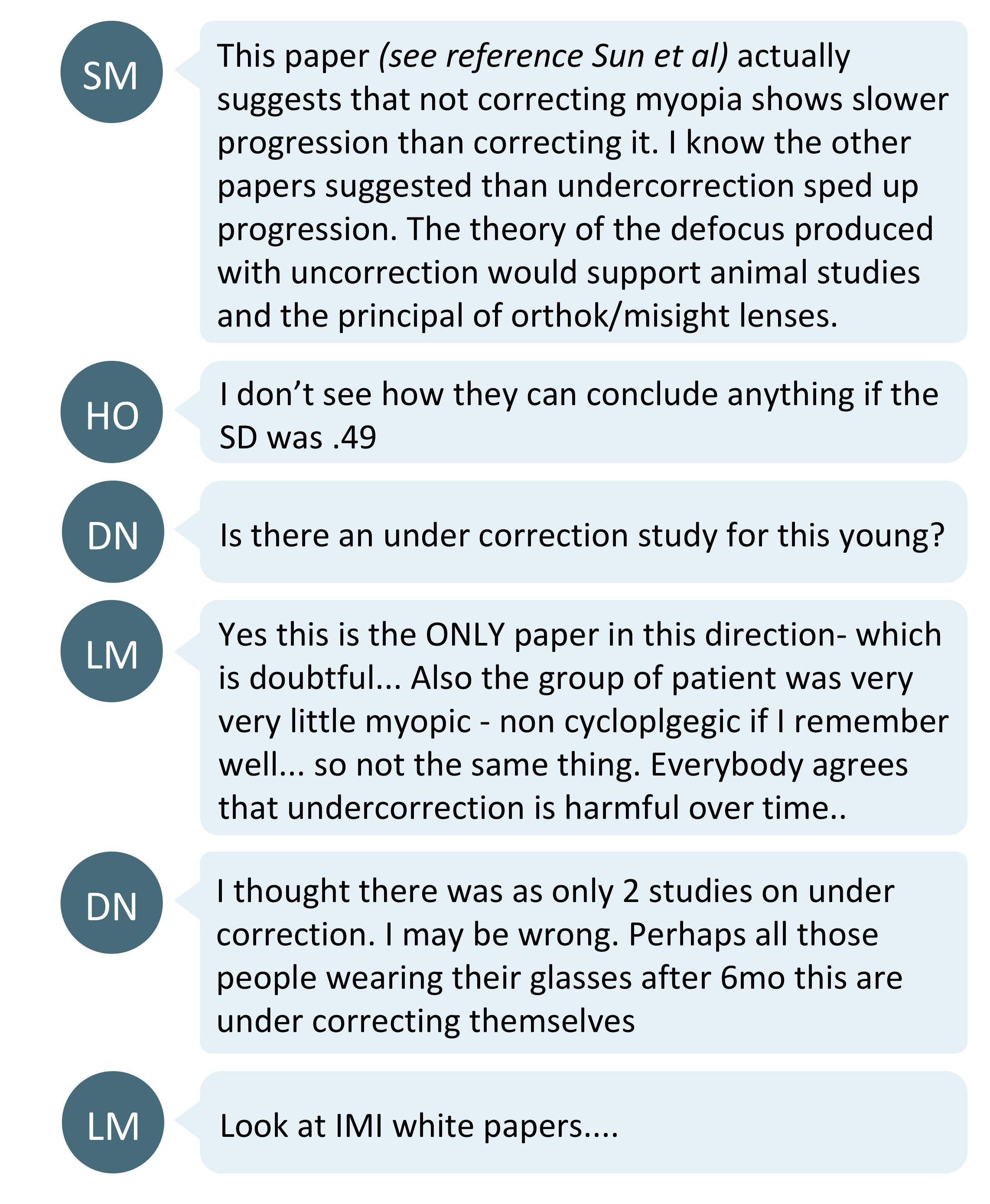
研究所说的是什么:
- Sun等人表明,没有近视矫正减缓了近视进展。1
- 李等人建议对近视的完全矫正和低估表现出相同的近视率进展。2
- Adler et al, Chung et al and Vasudevanet al showed undercorrection promote myopia progression.3-5
所有这些研究中最年轻的科目都是学龄儿童,对一个两岁的小孩来说,具有极大的视觉需求和任务。因此,难以推断这些孩子的结论。阅读更多关于粗略和未更正的内容,查看此研究博客which describes a recent meta-analysis paper on the topic. The conclusion of this meta-analysis was that undercorrection doesn't appear to be beneficial in myopia and is unlikely to be suitable as an intentional clinical management strategy.
'Time to monitor' group
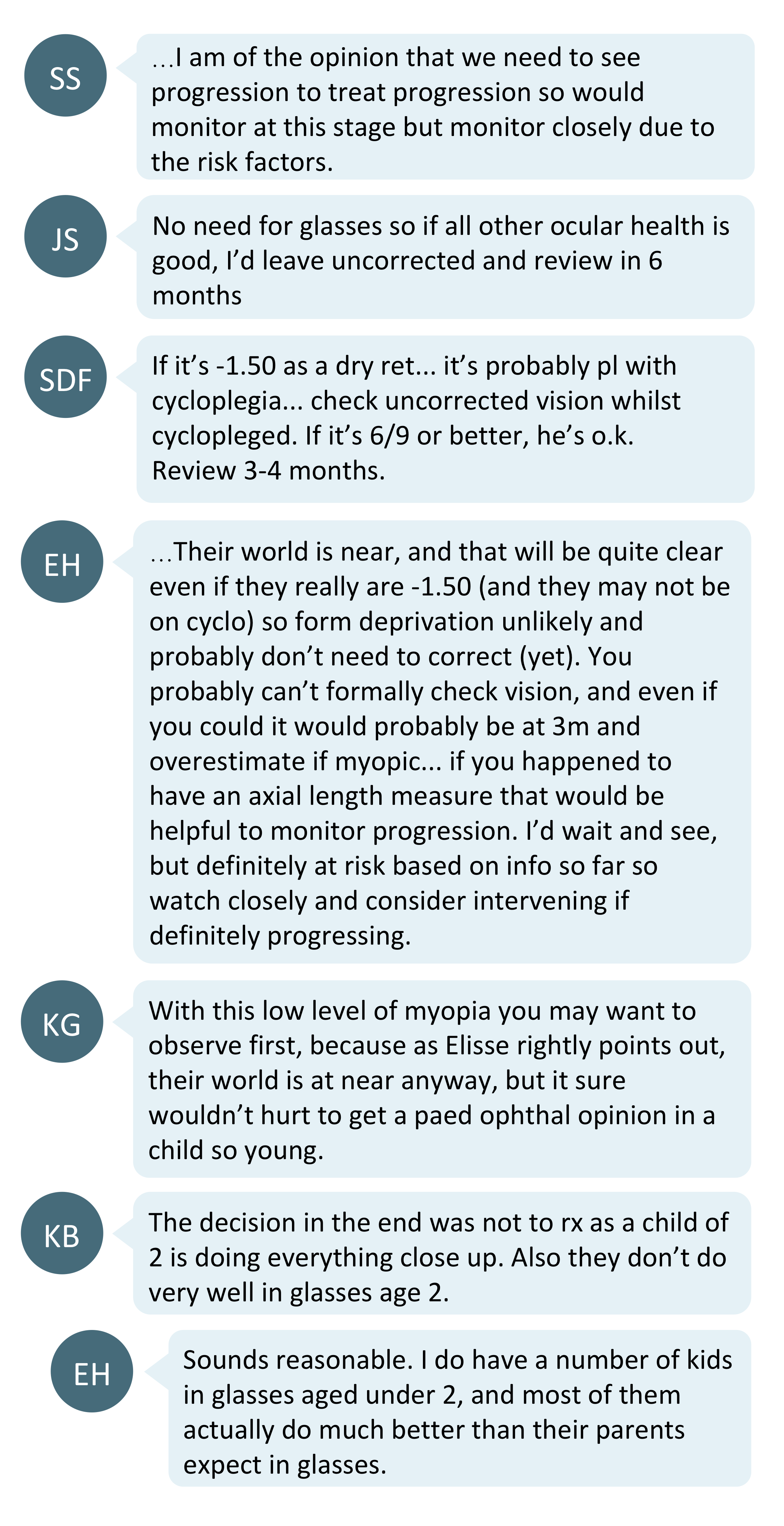
由于缺乏针对这个年龄组的近视控制研究,大多数评论者建议首先监测孩子。这个年龄的儿童视觉世界主要是关闭。因此,不纠正这种低水平的近视,对于这种孩子的世界完全清楚地,这种儿童完全明确了弱视弱视。
However, monitoring the child’s myopic progression is important. And whilst not everybody would necessarily prescribe glasses at this stage, documented progression would be a stronger indicator for intervention. It is also worth highlighting again that, despite the low myopia, the community did comment that seeking an opinion of a paediatric ophthalmologist would be important. In the case presented, the child had already seen an ophthalmologist. Whether this is mandatory or not will depend on the scope of practice in your country for managing children in this age group.
In looking to consensus on prescribing for toddlers, theAmerican Academy of Ophthalmology’s Preferred Practice Patterns for Pediatric Eye Evaluations (2017)advises correction for myopia of 3D or more at age 2 to <3 years. (Table 3) This data is given with a note that “these values were generated by consensus and are based solely on professional experience and clinical impressions because there are no scientifically rigorous published data for guidance. The exact values are unknown and may differ among age groups; they are presented as general guidelines that should be tailored to the individual child.” A research review published in 2011 recommended that for myopia without anisometropia or astigmatism, children 1-2 years of age be corrected for more than 2D of myopia once walking; from 2-4 years of age be corrected from 1.50D of myopia if it improves function. In both cases it’s suggested to reduce the refraction by 0.50-1.00D for emmetropization until age 4. You canread this open access paper here。从研究和共识中出现,基于这一第一次演示,它可能适合在这种情况下不规定校正。
Managing the visual environment

Regardless of whether one decides to correct this level of myopia at this stage, the consensus is that increasing time outside and reducing near work is an important part of managing this child.
研究表明,足够的室外时间可以减缓近视的发作,尽管在近视发作后减少进展中的作用是猜测。6Eyecare practitioners can recommend children spend at least 90 minutes a day outdoors. It is important to still encourage sun safety whilst doing this - that is to wear hats and sunglasses.
Excess near work is linked to increased rates of myopia progression,7根据美国儿科和澳大利亚政府卫生院,屏幕时间不推荐在2岁以下的儿童,出于各种发展原因 - 不仅仅是视觉。2-5岁的儿童被建议每天最多拥有一小时的屏幕时间。对于这些WebLinks和引用给父母,前往我的孩子愿景博客题为Close Work and Screen Time。
Take home messages:
- 10岁以下的儿童具有高近视(超过5-6D),应始终被儿科眼科和/或共同管理。这个孩子不是很高的关键,但非常年轻 - 考虑寻求儿科眼科医生对管理的看法对于非常年轻的近视的情况至关重要。您的国家可能是强制性的,具体取决于主要眼科护理实践的范围。在这种情况下,有人指出,孩子已经有眼科审查,重点是屈光管理。
- Prescribing glasses isn’t always the first necessary step when you are presented with the very young myope. Considering the visual needs of the child will aid that decision, and the research and consensus guidelines do support not prescribing, and observing, in this case. Very young children have a closer ‘world’ of visual tasks, and the key imperative at this age is to avoid amblyogenesis.
- 无论年龄段,应与父母讨论室外时间和近期工作时间的重要性。父母的资源可供选择188足彩比分直播My Kids Vision website.
Further reading on prescribing for young children

关于金伯利
Kimberley Nguis a clinical optometrist from Perth, Australia, with experience in patient education programs, having practiced in both Australia and Singapore.

关于Connie
康妮甘is a clinical optometrist from Kedah, Malaysia, who provides comprehensive vision care for children and runs the myopia management service in her clinical practice.
This educational content is brought to you thanks to unrestricted educational grant from

References:
- 太阳YY,李SM,李SY,康太,刘LR,孟B,咋ng FJ, Millodot M, Wang N. Effect of uncorrection versus full correction on myopia progression in 12-year-old children. Graefe's Archive for Clinical and Experimental Ophthalmology. 2017 Jan 1;255(1):189-195.(link)
- Li SY, Li SM, Zhou YH, Liu LR, Li H, Kang MT, Zhan SY, Wang N, Millodot M. Effect of undercorrection on myopia progression in 12-year-old children. Graefe's Archive for Clinical and Experimental Ophthalmology. 2015 Aug 1;253(8):1363-8.(link)
- Adler D,Millodot M.低估对儿童近视进展的可能效果。临床和实验验光。2006年9月; 89(5):315-21。(link)
- Chung K,Mohidin N,O'Leary DJ。近视近视增强而不是抑制近视的进展。视觉研究。2002年10月1日; 42(22):2555-9。(link)
- Vasudevan B, Esposito C, Peterson C, Coronado C, Ciuffreda KJ. Under-correction of human myopia–is it myopigenic?: a retrospective analysis of clinical refraction data. Journal of optometry. 2014 Jul 1;7(3):147-52.(link)
- Cao K, Wan Y, Yusufu M, Wang N. Significance of Outdoor Time for Myopia Prevention: A Systematic Review and Meta-Analysis Based on Randomized Controlled Trials. Ophthalmic research. 2020;63(2):97-105.(link)
- 黄鹤,昌DS,吴电脑。近期工作活动与儿童近视之间的关联 - 系统审查和荟萃分析。Plos一个。2015年10月20日; 10(10):E0140419。(link)