

I am an optometrist working most of the time in a community optometric practice and part-time as Director of Research at the Institute of Optometry. I have researched a few topics in optometry, but not until recently myopia. Yet, fifteen years ago, I developed a hatred of myopia and a keen interest in myopia control. This blog retraces my personal journey into myopia control and explains why I believe that this is the most important development for optometry that has taken place during my career.
图1表示任何社区验光师都会非常熟悉的情况。一个小男孩本(Ben)和两个近视父母,他们的正常远视开始减少4岁,直到6岁,他变得近视。
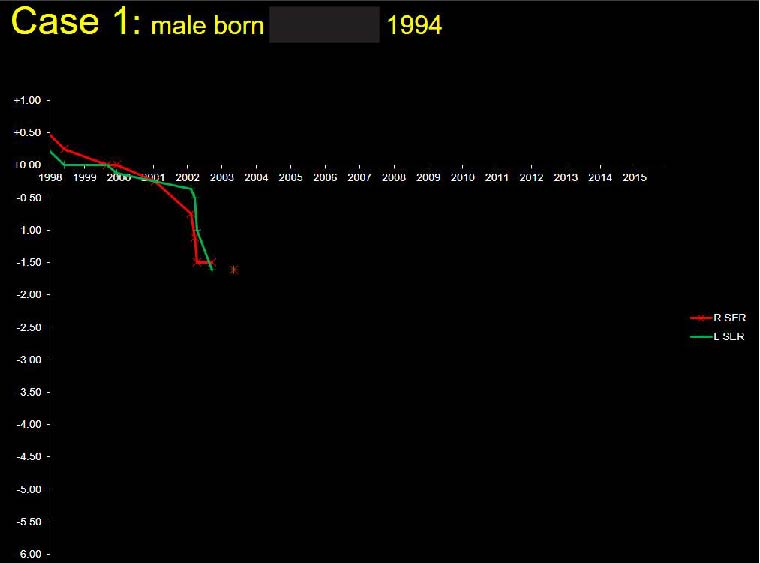
Figure 1 shows that the myopia started to progress quite rapidly and with such a young start and rapid progression it seemed inevitable that this boy’s destiny was to be a high myope. To any community optometrist this is an unremarkable scenario, but to me it was personal. This little boy just happened to be my son. As an optometrist, I was all too familiar with the mildly increased risks of ocular pathology in later life associated with myopia. Suddenly. the word “mildly” was not as reassuring as it had seemed when I had quoted this to many patients over the years. I wanted to do whatever I could to decrease the risk of high myopia.
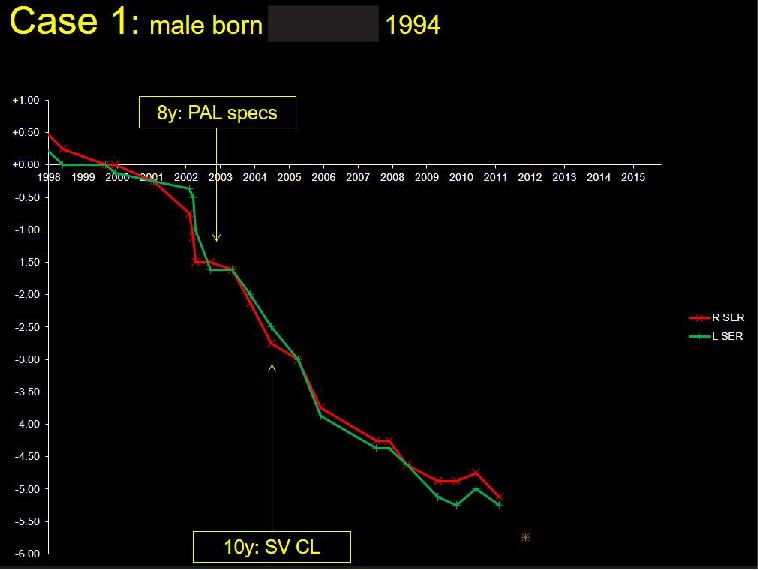
Ben was esophoric at near and some studies suggested that for esophoric myopes the progression of myopia can be slowed by multifocal spectacles.1, 2So, I prescribed progressive addition lens (PAL) spectacles. As Figure 2 shows, these had minimal effect on what seemed to be an inexorable progression of the myopia. At every eye exam I always discuss contact lenses with ametropic children, but Ben showed no interest until in 2004 he asked for soft contact lenses. We discussed Ortho-K but he was not keen. So, at the age of 10 years I fitted him with single vision daily disposable contact lenses.
The literature indicates that single vision contact lenses (SV CL) have no effect on myopia progression3图2显示了本的情况。到这个时候,我开始受到案例控制研究的出版物的兴趣,表明Ortho-K在减慢近视进展方面具有有益的作用。4, 5However, Ben was not interested in any type of contact lens with the word “rigid” in the name and I still had reservations about any form of overnight contact lens wear. The hypothesis that Ortho-K was having an effect at slowing myopia by correcting relative peripheral hyperopic defocus (RPHD)6,7开始听起来令人信服,我对汤姆·艾勒博士的工作感兴趣8, 9at creating a similar effect with centre distance multifocal contact lenses. My son and wife were just as keen as I was to slow the myopia and so in 2010 I fitted Ben with Proclear (later replaced by Biofinity) centre-distance multifocal contact lenses.
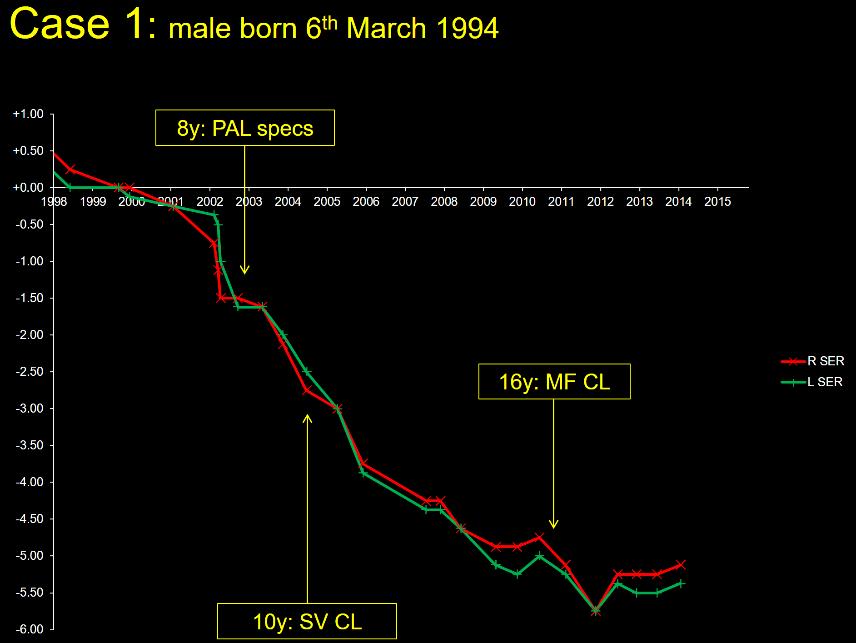
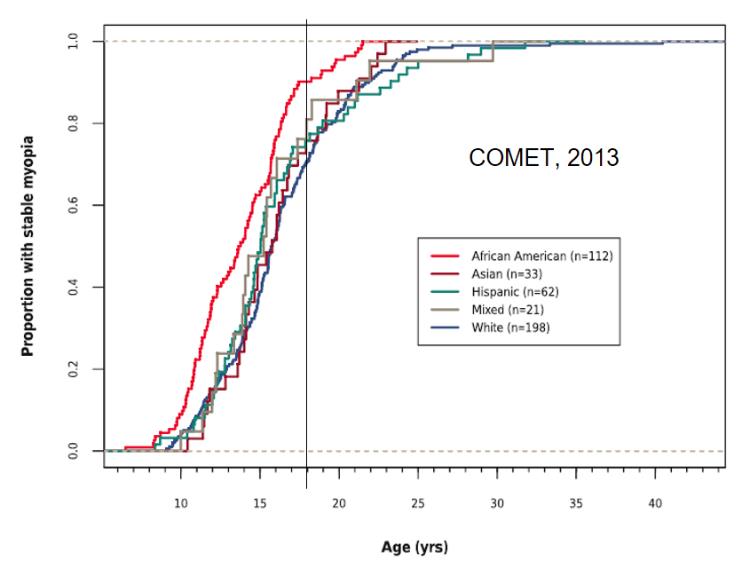
Figure 3 shows that the myopia stopped progressing soon after Ben was fitted with multifocal contact lenses. However, it is unwise to confuse an association with a cause and it is quite feasible that the myopia would have stopped progressing at the age of 16y even if Ben had not been fitted with multifocal lenses. Figure 4 shows, in the COMET study, that myopia typically does not stop progressing until the early twenties, but it certainly can stop sooner.
To me, as a parent, if the multifocal contact lenses were responsible for slowing or halting Ben’s myopia progression then I felt guilty about not having recommended this approach sooner. I had the excuse that good evidence was only just starting to accumulate that myopia progression seemed to be slowed by between one third and two thirds with Ortho-K4, 5, 10-16and with soft lenses whose multifocal design may correct RPHD.8、9、17-21
My experience with Ben and new interest in the research literature, especially a seminal paper by Flitcroft,22导致我对近视的看法改变了。我一直不喜欢眼镜,以及任何导致人们必须佩戴的眼镜。但是现在,我开始将近视视为敌人,并感到个人感到胆大,确实有义务与近视作战。我有责任让父母和孩子选择,如果他们愿意的话,他们与我一起尝试减缓近视的进展。
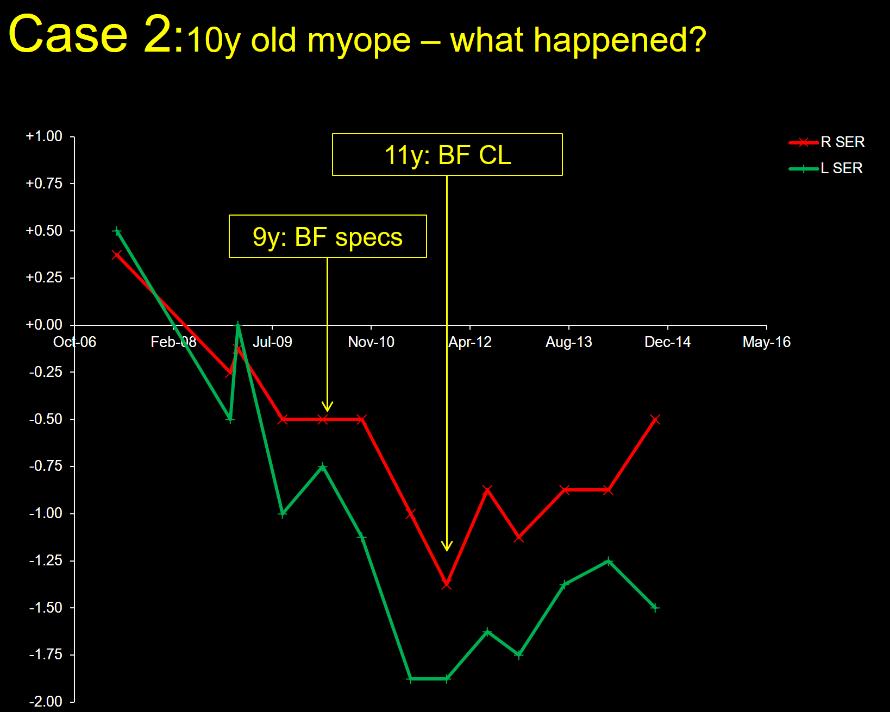
案例2是一个很好的例子,说明孩子,父母和从业者下定决心要尽其所能减慢近视。在2009年,这个10岁的女孩正在发展近视,并且附近的食管不足。23Bifocal spectacles solved the distance blur and eased the near symptoms, but as Figure 5 shows they did nothing to slow the myopia progression. After discussion of the options with the child and parents, they decided to undergo a fitting with centre-distance multifocal contact lenses.
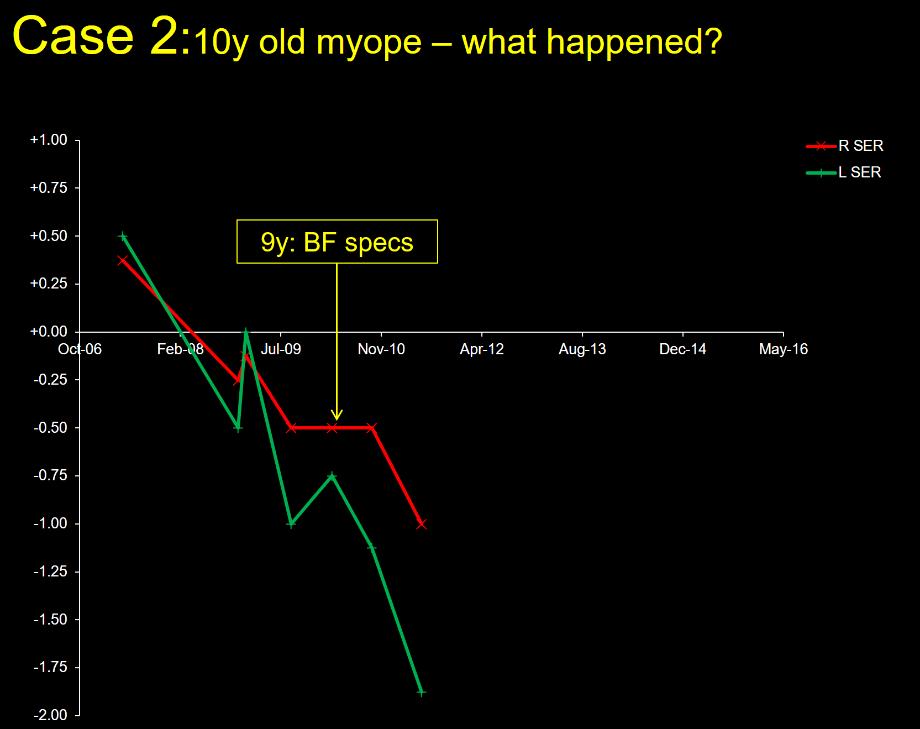
多病灶的隐形眼镜很好工作了中科院e 2 and Figure 6 shows that after she was fitted with centre distance multifocal contact lenses the myopia stopped progressing and even reversed a little. Case 2 was only aged 11y when she was fitted with multifocal contact lenses and so, unlike Case 1, it is extremely unlikely that the myopia would have stopped progressing this soon had she not undergone myopia control. Case 2 moved away in December 2014 but long before that I had been changed as an optometrist by my experience with these early cases and by emerging research publications. I was no longer prepared to surrender to myopia and simply watch, helpless, as it ran its course. When the child and the parent agree, we will fight together to do all that we can to slow the progression of this condition.
A few words of caution should be added, not least because of the natural bias to only present “good” cases as case studies. The treatment effects that have been described in this blog are based on average results in clinical trials. Some patients, like Case 2, do better than the typical results in the trials. But for others the opposite is true and for some cases the interventions described here show no effect at myopia control. At present, we cannot predict which cases will be successful, although there are some indications that children with esophoria at near and/or a high accommodative lag are likely to benefit most from myopia control. Kate Gifford’s excellent Myopia Profile tool highlights this and other risk factors for myopia development and progression.
隐形眼镜should only be fitted to children who are motivated and hygienic, and that goes for their parents too. Also, it is not for the practitioner to decide whether to undertake myopia control. The practitioner’s role is to inform the child and parents of the options and let them decide whether myopia control is for them. In my view, every optometrist should give this informed choice to every myopic child and parent.
我认为,允许验光师能够对抗近视进程的干预措施的发展代表了验光的地标。我们正在从纠正纠正的职业转变为一种对待的职业。这不仅仅是单词的改变。一些公众一直对我们的职业持怀疑态度,因为他们认为我们从屈光错误的纠正中受益。我认为我们现在有机会重新定义自己的角色。与父母和患者合作的从业者的共同目标,以最大程度地减少折射率的负担。我个人进入近视控制的旅程是我作为眼科专业人士角色的令人着迷和有益的发展。我希望我们的职业在近视控制中的旅程将加速,有一天我们可能会采取干预措施,可以有效地逆转和治愈近视。
致谢
我感谢儿子在此博客中允许我写关于他的允许。

关于Bruce
教授布鲁斯·埃文斯(Bruce Evans)是研究主任验光研究所in London, has published over 250 articles and several books, including textbook Pickwell’s Binocular Vision Anomalies. Bruce owns an独立实践在布伦特伍德,埃塞克斯,英格兰,在他的业余时间是一位狂热的水手。
References
- Fulk GW,Cyert LA,Parker de。单视性与双焦点透镜对食管儿童近视进展的作用的随机试验。Optom。VIS。科学。2000; 77:395-401。(link)
- Goss DA,Grosvenor T.童年时期的近视进展,双焦点是近点phoria的函数:三项研究的一致性。Optom Vis。科学。1990; 67:637-640。(link)
- Walline JJ, Jones LA, Sinnott L, et al. A randomized trial of the effect of soft contact lenses on myopia progression in children. Invest Ophthalmol Vis. Sci. 2008;49:4702-4706.(link)
- Cho P, Cheung SW, Edwards M. The longitudinal orthokeratology research in children (LORIC) in Hong Kong: a pilot study on refractive changes and myopic control. Curr Eye Res. 2005;30:71-80.(link)
- Walline JJ,Jones LA,Sinnott LT。角膜重塑和近视进展。Br J Ophthalmol。2009。(link)
- Smith EL. Prentice Award Lecture 2010: A case for peripheral optical treatment strategies for myopia. Optom. Vis. Sci. 2011;88:1029-1044.(link)
- Charman WN,Radhakrishnan H.外围折射和折射率的发展:审查。眼科生理学。2010; 30:321-338。(link)
- 所有的助教,罗兰,Wildsoet one-ye的结果ar prospective clinical trial (CONTROL) of the use of bifocal soft contact lenses to control myopia progression. Ophthal. Ophthal. Opt. 2006;26:8-9.(link)
- Aller TA, Wildsoet C. Bifocal soft contact lenses as a possible myopia control treatment: a case report involving identical twins. Clin. Exp. Optom. 2008;91:394-399.(link)
- Cho P, Cheung SW. Retardation of Myopia in Orthokeratology (ROMIO) Study: A 2-Year Randomized Clinical Trial. Invest Ophthalmol. Vis. Sci. 2012;53:7077-7085.(link)
- Santodomingo-Rubido J, Villa-Collar C, Gilmartin B, Gutierrez-Ortega R. Myopia control with orthokeratology contact lenses in Spain: refractive and biometric changes. Invest Ophthalmol. Vis. Sci. 2012;53:5060-5065.(link)
- Kakita T, Hiraoka T, Oshika T. Influence of overnight orthokeratology on axial elongation in childhood myopia. Invest Ophthalmol. Vis. Sci. 2011;52:2170-2174.(link)
- Hiraoka T,Kakita T,Okamoto F,Takahashi H,OshikaT。隔夜正差异学对儿童近视轴向长度伸长的长期影响:一项为期5年的随访研究。投资Ophthalmol。VIS。科学。2012; 53:3913-3919。(link)
- Charm J,Cho P. High Myopia部分还原Ortho-K:一项为期2年的随机研究。验光与视觉科学。2013; 90。(link)
- Swarbrick HA,Alharbi A,Watt K,Lum E,Kang P.使用新颖的研究设计在儿童正常角膜镜期间的近视控制。眼科。2014。(link)
- Paune J,Morales H,Armengol J,Quevedo L,Faria-Ribeiro M,Gonzalez-Meijome JM。近视控制具有新型的外围梯度软镜和正差异学:一项为期2年的临床试验。Biomed res int。2015; 2015:507572。(link)
- Walline JJ, Greiner KL, McVey ME, Jones-Jordan LA. Multifocal contact lens myopia control. Optom. Vis. Sci. 2013;90:1207-1214.(link)
- Anstice NS, Phillips JR. Effect of Dual-Focus Soft Contact Lens Wear on Axial Myopia Progression in Children. Ophthalmology. 2011.(link)
- Sankaridurg P, Holden B, Smith E, III, et al. Decrease in rate of myopia progression with a contact lens designed to reduce relative peripheral hyperopia: one-year results. Invest Ophthalmol. Vis. Sci. 2011;52:9362-9367.(link)
- Lam CS, Tang WC, Tse DY, Tang YY, To CH. Defocus Incorporated Soft Contact (DISC) lens slows myopia progression in Hong Kong Chinese schoolchildren: a 2-year randomised clinical trial. Br. J. Ophthalmol. 2013.(link)
- Konstantakopoulou E, Edgar DF, Harper RA, et al. Evaluation of a minor eye conditions scheme delivered by community optometrists. BMJ Open. 2016;6:e011832.(link)
- Flitcroft di。视网膜,光学和环境因素在近视病因学中的复杂相互作用。prog。视网膜。眼睛。2012; 31:622-660。(link)
- Evans BJW. Pickwell's Binocular Vision Anomalies. 5th ed. Oxford: Elsevier; 2007.(link)




Really brilliant insight and story. Thanks Bruce and Ben!
Bruce, I enjoyed your story and am glad you are now a committed myopia warrior. I think you might like to take a look at my app, Myappia – a myopia progression and control app. Let me know if you would like to alpha test it and I’ll send it your way.
这是非常鼓舞人心的。感谢分享
出色的文章,希望更多的验光师在美国练习近视控制