折射在儿童中可能具有挑战性,在复杂的演讲中,与与Myopia Profif Facebook社区共享的情况更加复杂。在开始近视治疗之前,必须确定地了解孩子的屈光状况。这个病人还是雌马?在处理一个复杂的假肌症,抗超跨性别和潜在远视时,所有患者都应该如何管理此类病例?答案涉及平衡目标,以管理Ametropia校正,双眼视力功能和近视控制。

这是一个总结this patient's refractive findings, as provided by the managing practitioner.
| Right eye | 左眼 | |
| Previous spectacles | -0.25 (6/6 or 20/20) | -1.50(6/45或20/160) |
| Unaided VA | 6/7.5+2(20/25+2) | 6/45(20/160) |
| Auto refractor | +0.25/-0.75×22 | -3.25/-0.50×166 |
| Subjective refraction (performed with +3.00 fog over contralateral eye) |
+0.25/-0.25×65(6/6-1或20/20-1) | -2.50/-1.00×165(6/6-1或20/20-1) |
| 干性视网膜镜检查 | +0.50/-0.50×180 (6/7.5+1或20/25+1) | -2.00/-0.75×180 (6/21+1或20/80+1) |
| Cycloplegic retinoscopy | +1.25/-0.75×180 | -1.50/-0.75×180 |
Binocular Vision testing results with patient wearing RE +0.25DS LE -2.50DS (similar to subjective refraction results) were reported as follows.
| Accommodative facility | Cleared +2.00 and -2.25 flippers with reasonable speed |
| Accommodative lag | R:+2.00 L:+1.50 |
| 负融合储量(基础,发散) | 休息12 /恢复10 |
| Positive fusional reserves (base-out, convergence) | 休息20 /恢复8 |
Refraction and binocular vision interaction
当各种折射率测试给出彼此截然不同的结果时,这可能会令人困惑。从这种情况下可以得出的共同点是,该患者的适应性系统不正常。我们可以在不同的折射率结果和高适应性滞后中看到这一点。另外,请注意,当眼部护理从业者在远视右眼推动时,近视左眼的敏锐度的改善 - l眼睛从6/45(20/160)改善,以-1.50至6/6-(20/20-(20/20-))当对侧眼 +3.00d雾气时,仅在主观折射时只有额外的-1.25最佳球体。然而,尽管这种动力的眼镜的敏锐度较差,但环读的折射率仅为-1.50左右。
The combination of the refraction and binocular vision outcomes point to accommodation and convergence insufficiency as well as accommodative spasm due to latent hyperopia in the R eye. All in all, this patient is suffering pseudomyopia and latent hyperopia in the R eye, giving additional (pseudo) myopia in the L eye, and presents with antimetropia - a subclass of anisometropia where one eye is hyperopic and the other myopic.
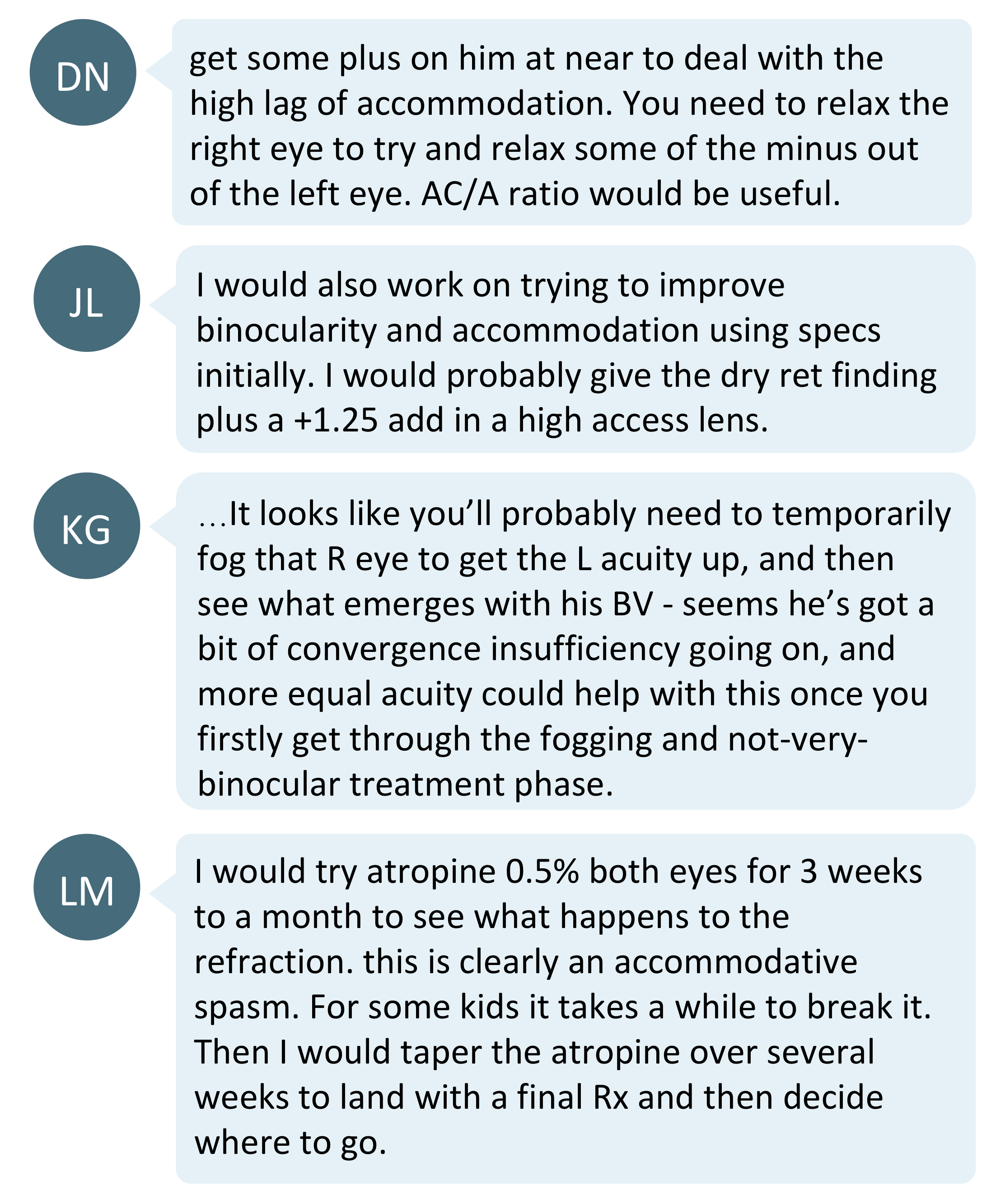
To address both the latent hyperopia in the R eye, which is likely causing accommodative spasm in the L (myopic) eye, managing the accommodative system was a common first management suggestion. There were a few potential ways discussed to achieve this.
- Prescribing plus at near to address the high accommodative lag.
- Fogging the R (hyperopic) eye with close-to-full correction to improve acuity in the myopic L eye with its true refraction.
- Using low-dose atropine to break the accommodative spasm. Doing this would require using a high enough dose of atropine to have the side effect of relaxing accommodation, while also managing the side effects of atropine - which takes us back to option 1!
Regardless of the means, the fact is that this child is unlikely to achieve normal acuity and comfortable binocular vision while the accommodation issues persist.
Other tests to help with refractive conundrums
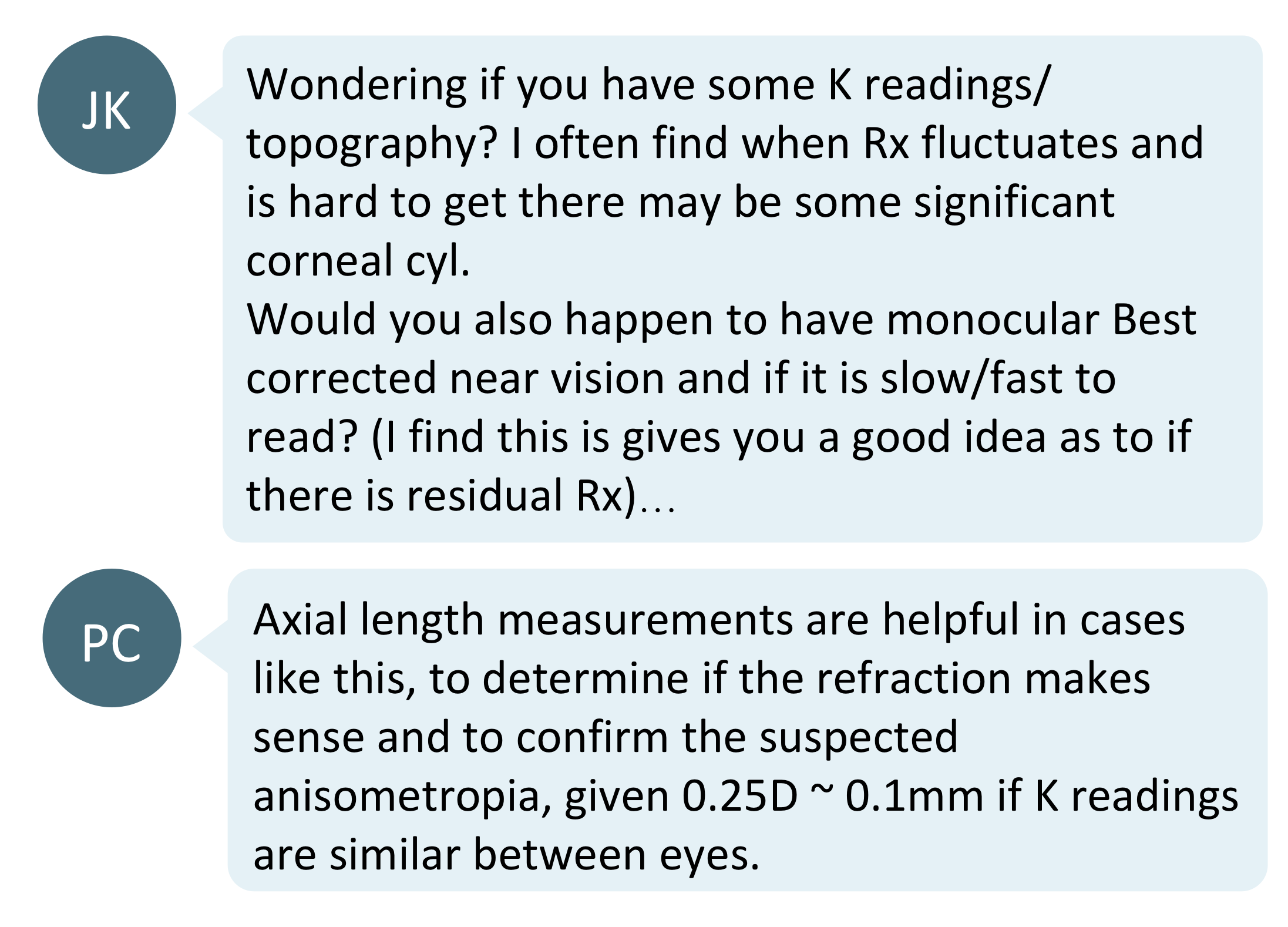
When different refraction methods deliver different results, it is useful to employ other testing strategies to help 'clear the fog' (pun intended!). JK and PC’s suggestions for measuring K readings and axial length can be a good reference point to guide the clinician’s diagnostic and management decisions.
How to manage refractive error?
现在,我们已经有了诊断的图片以及可能由环读性视网膜镜检查所示的最终或目标折射的图片,可以通过光学管理这个孩子的最佳方法是什么?决策过程中必须解决一些问题。
1. What power to prescribe?
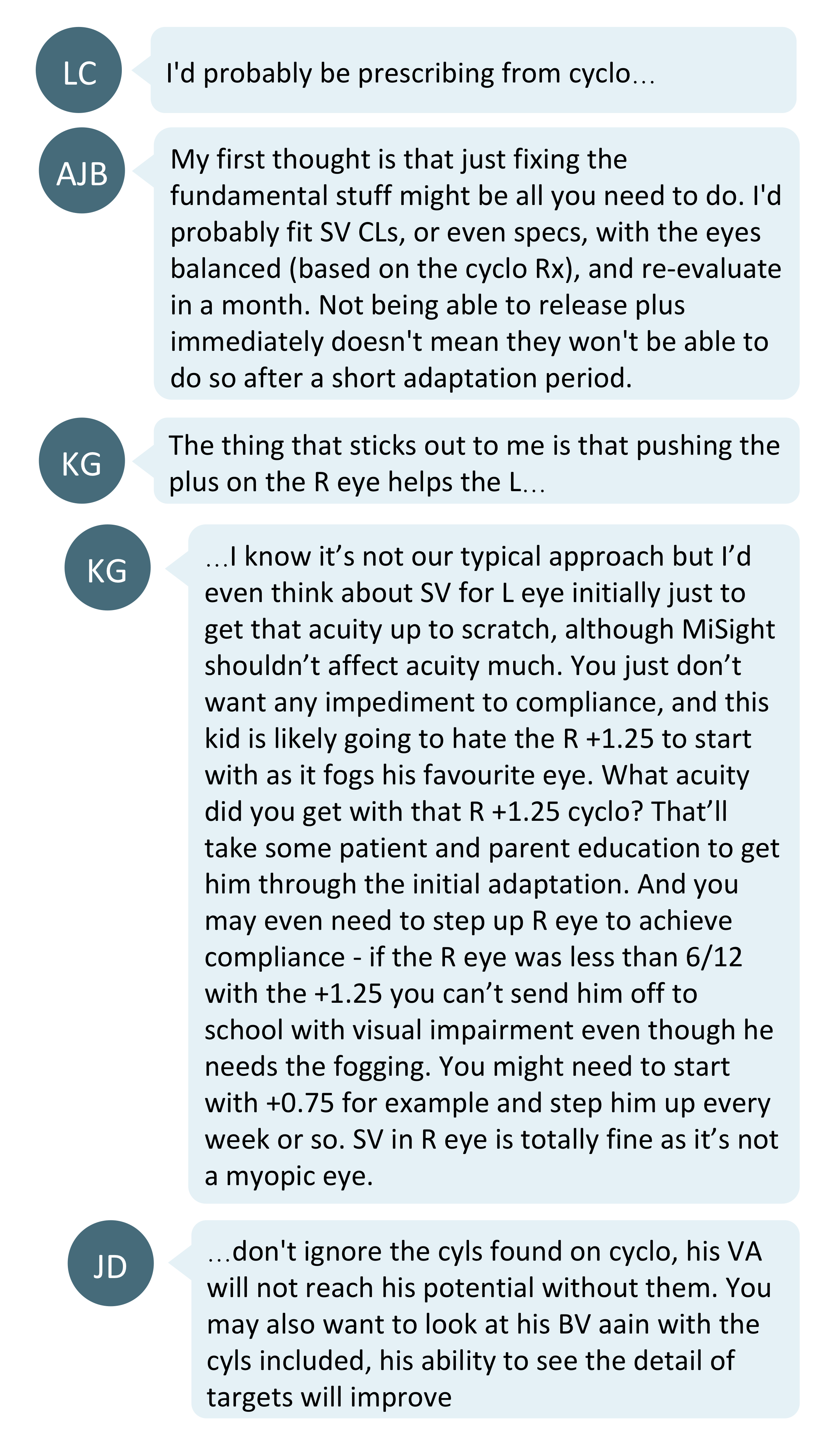
The cycloplegic retinoscopy results are approximately 1D more hyperopic than the dry subjective refraction results. Which power should a clinician prescribe to start with?
将周期性结果视为最终希望开出患者的终点,将主观折射结果视为该旅程的起点是有用的。
To prescribe a patient the cycloplegic result at the commencement of the management process could lead to disconcerting blur for the patient, difficult adaptation and poor compliance. Some colleagues suggested starting with the full cycloplegic refraction and hoping for swift adaptation. The success of this likely depends on what the acuity measurement was with the cycloplegic refraction, which was not reported. Some others suggested starting slightly more plus than the subjective refraction and increasing the plus from there.
2. Spectacles or contact lenses?

Some commenters favored using spectacles with an add to support the child’s accommodative system. There's more on this later in section 4 on managing binocular vision, below.
Others favored contact lenses for providing an easy, flexible way to change the prescription as the child adapts to increased plus in both eyes. Contact lenses can also help the patient better adapt to the increasingly plus prescription by being harder to remove than spectacles. Ultimately this is a balance between compliance, patient capability, cost of spectacle and/or contact lens replacement and the parent and patient preference.
3.对近视控制还是不控制近视?
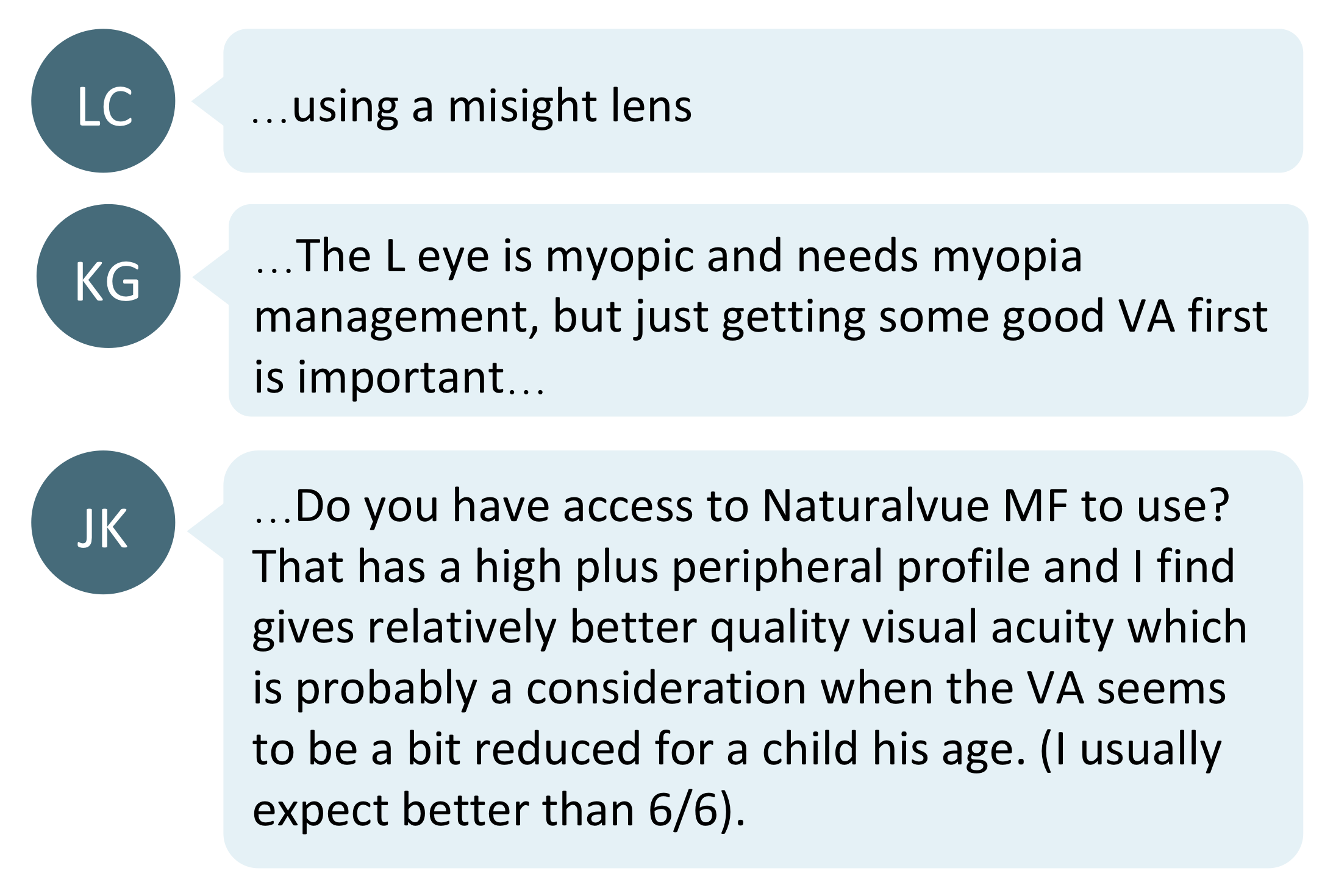
The next dilemma was whether it was better to use single vision lenses first to help with improving visual acuity in the L eye - recall that it was only 6/45 or 20/160 in the presenting prescription of L -1.50 when the cycloplegic retinoscopy was only slightly more minus than this at L -1.50/-0.75x180. Alternately, should a myopia control spectacle or contact lens be used for the left eye from the start of this management plan?
Myopia controlling contact lenses (MiSight, NaturalVue and multifocal contact lenses, in the original post) were suggested as options that could strike the balance of correcting and controlling myopia, while also achieving good corrected acuity. We can establish that this child is not amblyopic as he was able to reach 6/6 at some point during the refractive testing process.
抗超时性近视控制?
Retrospective case series research has shown that treating anisometropic patients with an orthokeratology lens for the myopic eye can significantly slow myopia progression and axial elongation in that myopic eye, without slowing the desired growth of emmetropization in a contralateral, emmetropic eye.1,2
将这些数据伸向当前患者很有趣,因为人们需要减慢L近视眼的生长,但是R Eye的生长减慢可能导致持续的远视。已发表的数据表明,至少有了潜在的正差异,这不会干扰这位11岁患者的R Eye的润气化过程(并希望减少远视)。
4. What about managing binocular vision?
在急于将这个孩子与近视固定在l眼中的近视镜头之前,还有一个考虑在平衡近视校正,近视控制和双眼视力功能的临床目标方面还有一个考虑因素。如果临床医生希望为双眼视力支撑提供附近的添加,那么如上所述,控制了住宿,则控制隐形眼镜的近视可能无法提供此功能,以及渐进式添加或双焦点眼镜镜头。各种研究表明,多灶性隐形眼镜(MFCL-在此使用此术语在其设计中使用多种折射力)并不会像奇观镜头那样导致儿童和年轻人的适应性滞后。实际上,越来越多的证据表明,年轻穿着者的MFCL实际上可能会减少适应性的反应,有效地增加滞后,并且这种效果在镜头设计中可能会有所不同。3-5
By comparison, orthokeratology (OK) appears to decrease accommodative lag slightly.6The issue with this patient, though, is that monocular OK won't be likely support accommodation by decreasing lag in both eyes; not as consistently as a spectacle lens add - one study has shown a reduction in accommodative lag by an average of 0.39D per 1D increase in lens add power, although there is much individual variation.7
Why does managing BV matter? When the eyes have unequal accommodation demand, the eye which requires the least accommodative effort to maintain clear focus of the target will control the accommodative response in both eyes. The other eye will experience blurry images, and this retinal defocus can stimulate myopia progression.8
In the case of this patient it seems the over-accommodation of the R eye to deal with latent hyperopia has led to pseudo-myopia in the R eye and excess (pseudo) myopia in the L eye. This has led to blurred distance vision in the L eye and potentially could have contributed to additional myopia progression. Hence, addressing the binocular vision issues is key to the overall patient management and L eye myopia management strategy.
Take home messages:
- When refracting complex cases such as this, the cycloplegic retinoscopy result provides the end point or goal refraction, but the starting point may be more likely the subjective refraction. Fogging the contralateral eye for subjective refraction helped to improve acuity.
- In cases where one might want to slowly change a prescription over time, contact lenses are a good option, but in this case management of the binocular vision disorders may lend themselves more to spectacle correction - primarily by providing a stronger 'add' effect at near.
- The interaction between binocular vision function, refraction and acuity is highly important in firstly determining the management strategy and secondly managing refractive changes over time - this being myopia management for one eye and potential emmetropization for the other eye.
- 在这样的复杂案例中,上面的同事的讨论和建议表明,没有人可以进行“正确”的方法,还有许多好的开始方法。在管理双眼视力,Ametropia校正和近视控制方面,要在短期内实现舒适的愿景,并在长期内降低眼睛健康的风险之间,将达到平衡。

关于金伯利
Kimberley Nguis a clinical optometrist from Perth, Australia, with experience in patient education programs, having practiced in both Australia and Singapore.

This educational content is brought to you thanks to unrestricted educational grant from

References:
- Cheung SW, Cho P, Fan D. Asymmetrical increase in axial length in the two eyes of a monocular orthokeratology patient. Optom Vis Sci. 2004;81(9):653-665.(link)
- Tsai WS, Wang JH, Lee YC, Chiu CJ. Assessing the change of anisometropia in unilateral myopic children receiving monocular orthokeratology treatment. J Formosan Med Assoc. 2019;118(7):1122-1128.(link)
- Gong CR, Troilo D, Richdale K. Accommodation and Phoria in Children Wearing Multifocal Contact Lenses. Optom Vis Sci. 2017;94(3):353-60.(link)
- Kang P, Wildsoet CF. Acute and short-term changes in visual function with multifocal soft contact lens wear in young adults. Cont Lens Anterior Eye. 2016;39(2):133-40.(link)
- 吉福德KL,施密德KL,柯林斯J,马赫C, Makan R, Nguyen TKP, et al. Accommodative responses of young adult myopes wearing multifocal contact lenses. Invest Ophthalmol Vis Sci. 2019;60(9):6376.(link)
- Gifford KL, Gifford P, Hendicott PL & Schmid KL. Zone of Clear Single Binocular Vision in Myopic Orthokeratology. Eye Contact Lens 2020;46:82-90.(link)
- Cheng D,Schmid KL,Woo GC。正镜的添加和基础棱镜对中国近视儿童的适应准确性和接近水平的佛罗里亚的影响。眼科生理学Opt 2008; 28:225-237。(link)
- Charman WN. Aniso‐accommodation as a possible factor in myopia development. Ophthalmic Physiol Opt. 2004;24(5):471-479.(link)